 Skip to content

Professional Installation of Epoxy Flooring for Industrial Facilities.
Professional Installation of Epoxy Flooring for Industrial Facilities
At Epoxy Floors NJ, we know a high-performance floor is only as resilient as the preparation behind it. Since 1988, our team has refined a meticulous installation process designed to transform vulnerable concrete into a seamless, durable surface engineered for heavy commercial and industrial demands.

Our Multi-Step Installation Process
Epoxy flooring failure is most frequently caused by inadequate surface preparation. We adhere to strict industry standards—including guidelines from the American Concrete Institute (ACI)—to guarantee a permanent, structural bond.
Mechanical Substrate Preparation
We use heavy-duty industrial diamond grinders to open concrete pores, ensuring a permanent mechanical bond for high-traffic environments.
Crack and Joint Repair
We meticulously inspect the slab and fill all cracks, pits, and spalls using high-strength epoxy to establish a sound foundation.
Moisture Vapor Mitigation
Specialized moisture-vapor barrier primers seal New Jersey concrete slabs against hydrostatic pressure and outgassing bubbles.
High-Build Resin Base Coats
100% solids industrial epoxy base and grout coats are applied to build the required thickness and impact resistance.
Protective Topcoat Application
An advanced polyaspartic or urethane topcoat provides extreme scratch, chemical, and UV resistance for lasting durability.
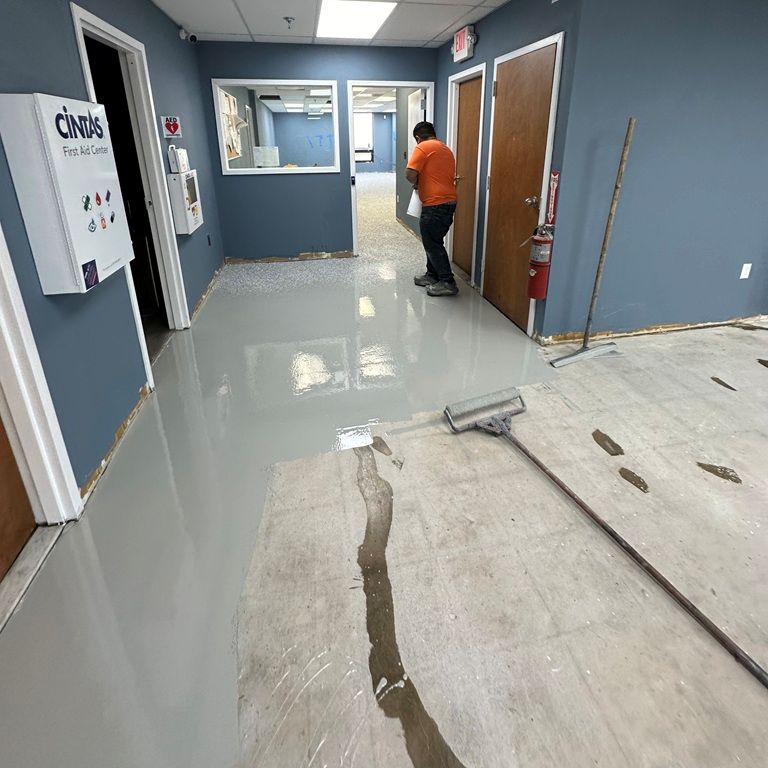
Tailored Resinous Systems Since 1988
Depending on your facility’s operational environment, we customize the installation layer:
Flake Systems: Decorative vinyl chips broadcast into wet base coats for durable, slip-resistant commercial spaces.
Metallic Systems: Hand-swirled specialized metallic pigments creating a high-end, marble-like aesthetic.
Urethane Cement: Heavy-duty thermal shock-resistant systems built for commercial kitchens and food processing facilities.
Contact us today for a free consultation, and let our 38 years of experience protect your facility.

FAQ About Installation of Epoxy Flooring
Unlike DIY acid etching, which only cleans the surface, mechanical diamond grinding physically opens the “pores” of the concrete. This creates a rough profile that allows the epoxy to achieve a permanent mechanical bond, preventing peeling and flaking.
A professional installation never coats over a compromised foundation. The team uses high-strength epoxy fillers to repair cracks, pits, and joints before any coating is applied, ensuring the final result is perfectly level and structurally sound.
To combat New Jersey’s humidity and high water tables, a moisture-vapor barrier primer is applied. This seals the slab to prevent “outgassing” (air bubbles) and protects the floor from hydrostatic pressure that could otherwise cause delamination.
The high-solids base coat provides the floor’s thickness and impact resistance for heavy machinery. The topcoat (typically polyaspartic or urethane) acts as the “armor,” offering scratch resistance, chemical protection, and UV stability to prevent yellowing.
Yes. During the decorative layer step, you can choose between flake systems (vinyl chips broadcast into the wet epoxy) or metallic systems (pigments swirled to create a marble-like effect) to match your facility’s aesthetic.